The right fit depends on your sales channels, transaction volume, average ticket size, industry, existing software, and how much hand-holding you want. It's rarely about grabbing the lowest advertised rate.
Card payments keep climbing too. In 2023, credit and debit cards made up 62% of all U.S. consumer payments (32% credit, 30% debit), according to the Federal Reserve's 2024 Diary of Consumer Payment Choice. Card acceptance isn't optional anymore. It's the baseline.
This guide walks through the framework: understanding what a provider actually does, pricing transparency, payment capabilities, security and funding, and the factor merchants most often regret overlooking, customer service.
Key Takeaways
- Compare total processing cost and effective rate, not just a promotional transaction rate.
- Confirm support for every channel you use: in-person, online, mobile, keyed, recurring, invoice, and ACH.
- Review PCI duties, fraud tools, chargeback procedures, and funding timelines before you sign.
- Check integrations, reporting, equipment terms, and contract flexibility against your workflow.
- Treat customer service as a core requirement: a single point of contact, U.S.-based 24/7/365 support, and your dedicated representative's cell phone number.
- Know whether you're getting your own merchant account or becoming a sub-merchant on an aggregator's platform.
What Is a Merchant Services Provider?
A merchant services provider helps your business accept, authorize, process, secure, report on, and settle electronic payments. That usually means bundling a merchant account, processing, a payment gateway, terminals or POS tools, and ongoing support into one relationship.
Dedicated Merchant Account vs. Aggregated Platform
There are two common structures, and neither is universally better:
- Dedicated merchant account providers need a fuller application and often a credit check, but typically offer more pricing flexibility and underwriting tailored to your business.
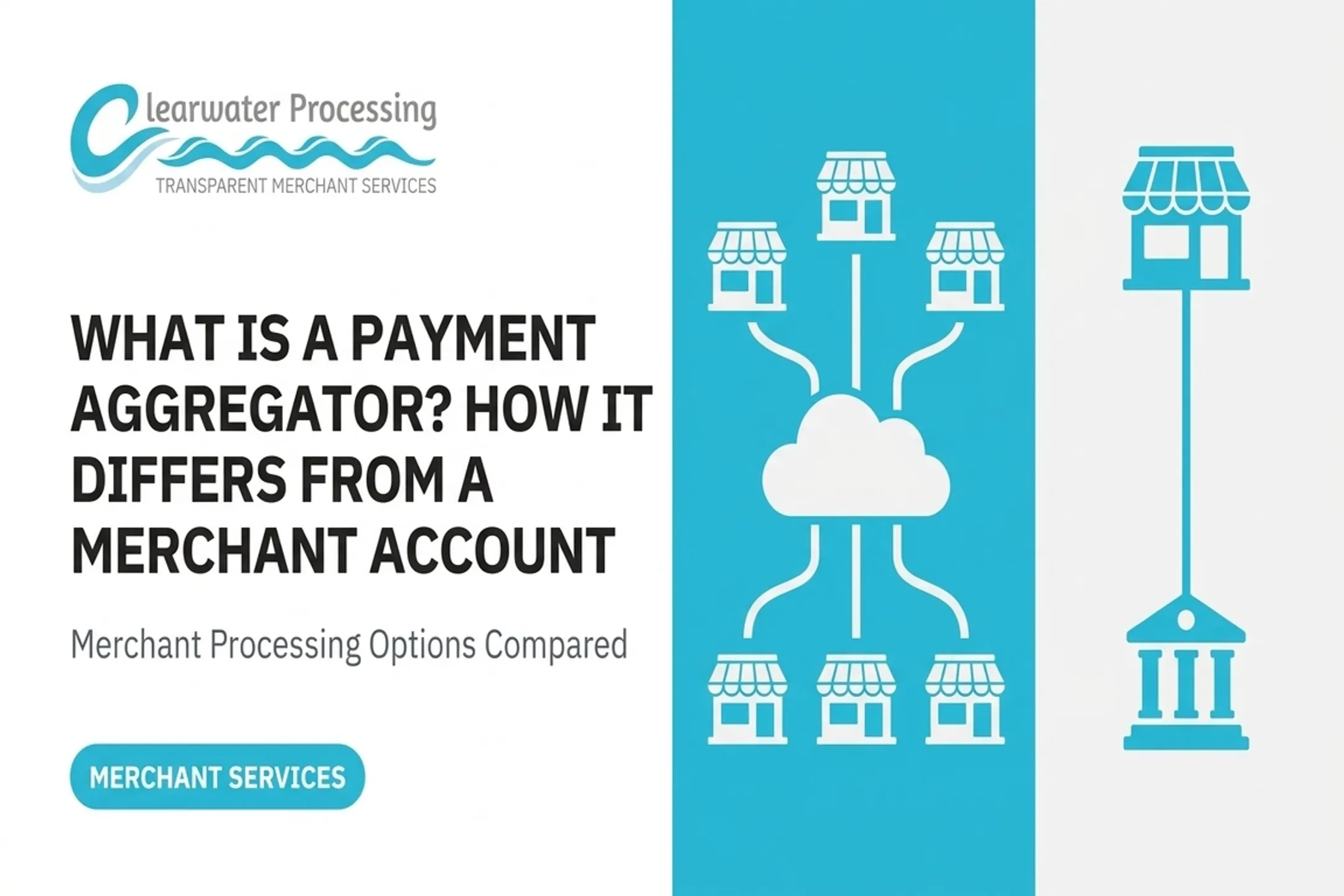
- Aggregated payment platforms (payment facilitators, like Stripe, PayPal, or Square) let you accept payments without your own merchant account. You onboard faster as a sub-merchant under the aggregator's shared master account, often with simpler flat-rate pricing. See the pros and cons of flat-rate processing these platforms rely on before you sign up.
Payment facilitators generally trade faster onboarding for a less individualized account structure, while dedicated accounts take longer to set up but can offer more control over pricing and terms. With an aggregator, you don't control the relationship: you must abide by the aggregator's own rules and regulations, which are often much more stringent than Visa, Mastercard, and American Express rules. Faster setup doesn't mean fewer holds later. Aggregator accounts can apply reserves, freeze payouts, or flag your account for review under those rules. Refunds differ too: Clearwater returns the interchange merchants paid when a refund on Visa and Mastercard is issued, while Stripe keeps its fee. Per Stripe's own published pricing, on standard pricing "the payment processing, Connect and currency conversion fees from the original transaction are not returned." For a fuller breakdown of how the two models compare, see the pros and cons of payment aggregators like Stripe, Square and PayPal.
Support is the other big difference. On an aggregated platform, help usually means a ticket queue, an email form, or a chat box, and nobody on the other end knows your business. A dedicated merchant services provider like Clearwater gives you a single point of contact: a real person with industry experience whose direct cell phone number you have, backed by U.S.-based support 24/7/365. When a deposit is held or a terminal goes down, that difference matters more than a fraction of a percent on your rate.
How a Transaction Actually Moves
After a customer pays, the transaction moves through three stages:
- Authorization: the issuer approves or declines the charge
- Clearing: the transaction routes through the card network
- Settlement: funds move toward your bank account
Refunds and disputes can still happen after settlement. That is why funding timelines and chargeback handling matter as much as the initial swipe.

Core Components of Merchant Services
Think of merchant services as a connected environment, not a pile of separate products. The right combination depends entirely on how you sell and collect money.
Merchant account and payment processing is the foundation: it's how transactions get approved, settled, and deposited into your bank. Ask specifically about funding schedules, cutoff times, and whether reserves apply to your account type.
Payment gateway and virtual terminal tools handle card-not-present situations:
- Online checkout on your website
- Keyed transactions for phone orders
- Email payment links
- Recurring or invoice-based billing
Terminals, mobile readers, and POS systems cover card-present sales:
- Swipe, dip, tap, and contactless acceptance
- Receipt printing
- Inventory tracking where needed
Reporting, reconciliation, and integrations tie it all together. Payment data should flow into your accounting software, invoicing tools, CRM, or ecommerce platform automatically. Manual reconciliation eats hours every month. A good integration removes that work entirely.
Benefits of Merchant Services
Reliable payment acceptance directly affects revenue.
Strong merchant services improve day-to-day operations in a few concrete ways:
- Fewer failed transactions and abandoned checkouts
- Payment acceptance across physical, online, mobile, and remote channels
- Timely funding and clear reporting so cash flow is visible, not guessed
Security features worth confirming (verify specifics with any provider you're evaluating):
- Tokenization or encryption of card data
- PCI compliance support and guidance
- Fraud monitoring and chargeback management
- Breach protection or insurance coverage
Clearwater's PCI compliance program, for instance, includes $100,000 breach protection insurance.
The same stack often adds tools for recurring billing, saved payment methods, and payment links when you need them. A wedding planner collecting staged deposits needs different features than a wholesale distributor invoicing net-30 clients. Both still gain from automation that cuts manual entry.
What to Consider When Choosing the Best Merchant Services Provider
Provider selection isn't one-size-fits-all. It varies by business size, industry, whether you're mostly card-present or card-not-present, transaction volume, average ticket, and growth plans.
The criteria below connect payment-service specifications to outcomes you can actually measure: effective processing cost, funding reliability, reconciliation time, approval rates, and how fast support resolves a dispute.
Pricing Transparency and Total Cost
Get a complete fee breakdown before you sign anything. That means:
- Processor fees and interchange/network costs
- Monthly and annual fees
- Gateway or PCI compliance fees
- Equipment costs
- Chargeback and batch fees
- Statement fees, minimums, and reserve requirements
Pricing generally falls into three models:
- Interchange-plus: Separates interchange, card-brand assessments, and processor fees into distinct line items
- Tiered pricing: Groups transactions into qualified, mid-qualified, and non-qualified buckets
- Flat-rate pricing: Charges one published rate without breaking out underlying interchange
No single model is automatically cheaper. Compare proposals using your actual recent transaction statements, not a hypothetical scenario, and look at the effective rate (total fees divided by total volume) rather than a headline percentage.
Clearwater's merchant statement analysis reviews statements from local banks or national processors to flag confusing line items. Reported client savings average 10%–30%.

Payment Methods and Sales-Channel Coverage
Confirm the provider actually supports every channel you use:
- In-person tap, dip, or swipe
- Online checkout
- Keyed or virtual-terminal transactions
- Payment links and mobile payments
- ACH or e-checks
- Recurring billing
Match the tool to how you actually get paid:
- Retailers need solid EMV terminal hardware
- Ecommerce sellers need a reliable gateway
- Contractors collecting field deposits need mobile or keyed capability
- B2B firms taking invoice payments by phone and email need a virtual terminal, not a countertop reader
Integrations, Equipment, and Workflow Fit
Before signing, verify compatibility with your POS, ecommerce platform, accounting software, CRM, invoicing tools, and any custom or industry-specific application (parking software, practice management systems, or other tools that run day-to-day operations).
Also check hardware terms: ownership versus leasing, replacement policy, warranty coverage, and connectivity requirements. Clearwater's QuickBooks and Xero integration, for example, plugs into existing accounting workflows without forcing a software switch.
Security, PCI Compliance, and Risk Controls
Under PCI DSS, merchants share responsibility for protecting cardholder data. The standard applies to any business that stores, processes, or transmits card information, not just the processor. The PCI Security Standards Council's own guidance calls for qualified partners, staff training, and properly configured devices as baseline requirements.
Ask directly:
- What encryption or tokenization is used?
- What fraud screening and address verification checks apply?
- How are chargebacks handled, and is there dispute assistance?
- What happens in a breach — is there insurance, and what does it actually cover?
Advertised safeguards and contractual coverage aren't always the same thing. Get the specifics in writing.
Funding Reliability, Underwriting, and Contract Terms
Funding timelines vary significantly by provider. Some platforms advertise next-business-day transfers with a defined cutoff time; others note that initial payouts can take longer depending on industry risk and account verification. Ask specifically about:
- Standard funding schedule and cutoff times
- Weekend and holiday processing
- Reserve policies and what triggers them
- Circumstances that could delay or hold funds
Then read the contract itself. Look for contract length, automatic renewal clauses, cancellation fees, rate-change provisions, and equipment return requirements. Hold and reserve terms matter most for merchants in higher-risk categories like recurring billing or high-ticket B2B sales, so get them in writing.
Customer Service, Reporting, and Long-Term Scalability
Customer service is where merchant services providers differ most, and where a bad fit costs the most. When a deposit is held or a terminal goes down on a Saturday, the question isn't your rate. It's who picks up the phone.
Test support before you sign, not after something breaks. Look for:
- A single point of contact: a real human with industry experience who knows your account, rather than a call center, ticket queue, or chat bot
- U.S.-based support available 24/7/365, including nights, weekends, and holidays
- Your dedicated representative's direct cell phone number, so urgent issues reach someone who can act on them
- Clear escalation paths for disputes, held funds, and outages
Finally, evaluate the reporting dashboard itself. Can you see transaction detail, deposits, refunds, and chargebacks in one place? And can the provider support future locations, higher volume, or new sales channels without forcing a disruptive migration down the road?
How Clearwater Processing Can Help
Clearwater Processing has operated in merchant services since 2003, working from South Florida, New York City, and Arizona while serving businesses across 32 states.
Clearwater builds each setup around how a business actually collects money:
- Ecommerce gateways with API access, all card types, and next-day funding for online sellers
- Back-office billing with reporting, statement analysis, and next-day settlement for recurring or subscription models, plus automatic customer card updating for expiring cards, which saves time and retains revenue automatically
- Stand-alone EMV terminals for retail and card-present transactions
- Chargeback loss mitigation, working directly with merchants and with trusted partner companies, backed by some of the largest financial institutions in the country, that offer chargeback insurance products
- PCI compliance support, including $100,000 breach protection insurance
- Merchant reporting portal for transaction detail, statements, and account activity
Those options line up with the criteria above: pricing transparency, channel coverage, security, and support. Service is where Clearwater stands apart: every client gets a single point of contact, a dedicated representative with industry experience whose personal cell phone number you can call directly, backed by U.S.-based backend phone support 24/7/365.

For merchants who've been with a processor for years and suspect they're overpaying, Clearwater offers a merchant statement analysis. The team reviews statements from local banks or national processors to identify confusing fees and line items.
If you're evaluating a new provider or want a second opinion on your current one, start with your latest processing statement. Talk through your payment channels, integrations, and funding needs before you switch.
Conclusion
The right merchant services provider fits your payment channels, systems, risk profile, and service expectations. The lowest advertised rate alone rarely reflects true cost or long-term fit.
Before signing anything:
- Calculate total cost from your actual transaction statements, not sample rates
- Inspect renewal, cancellation, and rate-change clauses before you commit
- Verify integrations with your systems and the payment methods you need
- Confirm security controls, PCI responsibilities, and funding policies in writing
- Test customer service now, before a funding or outage issue hits: confirm U.S.-based support and a direct line to your representative
Fees, transaction mix, and support needs change over time. Revisit your provider's performance periodically instead of assuming today's setup still fits tomorrow's business.
Frequently Asked Questions
What is the average rate for merchant services?
There's no single average that applies across businesses. Rates depend on pricing model, card mix, transaction size, sales channel, and industry. Compare your effective rate and total cost using your own statements, not a generic published number.
What is the best way to accept payments for a small business?
It depends on how you sell: in person, online, remotely, or through recurring billing. Choose a provider that combines the payment methods you actually need with transparent pricing, security, and the right equipment or integrations.
What are some examples of merchant services?
Merchant accounts, card processing, payment gateways, virtual terminals, POS systems, and payment terminals are common examples. Others include mobile payments, invoicing, recurring billing, reporting tools, PCI support, and chargeback assistance.
What is the difference between a merchant services provider and a payment aggregator?
A merchant services provider sets up a dedicated merchant account in your business's name. A payment aggregator, like Stripe, PayPal, or Square, boards you as a sub-merchant under its own master account. Aggregators are fast to set up, but you don't control the relationship and must follow the aggregator's own rules, which are often stricter than card-brand rules. Support differs too: aggregators typically rely on tickets or chat, while a dedicated provider like Clearwater gives you a single point of contact you can call directly. Our breakdown of the pros and cons of payment aggregators like Stripe, Square and PayPal covers the trade-offs in detail, and our guide shows how a direct merchant account compares with a payment aggregator. For how their pricing plays out in practice, see the pros and cons of flat-rate credit card processing.
Does Clearwater Processing offer 24/7 U.S.-based customer service?
Yes. Clearwater provides U.S.-based backend phone support 24/7/365, and every client has a single point of contact: a dedicated representative whose personal cell phone number they can call directly.