Introduction
A processor advertises a simple flat rate and it sounds straightforward enough. Then the statement arrives with batch fees, PCI fees, a gateway charge, and a chargeback line item nobody explained upfront.
Many merchants struggle to compare credit card processing services because the advertised rate rarely reflects the real cost. That cost shifts based on transaction type, card mix, sales channel, and monthly volume.
The stakes go beyond pricing. Your processor affects checkout reliability, how fast money hits your bank account, payment security, and the reporting you rely on to run the business.
For retailers, ecommerce sellers, contractors, and professional service firms alike, the wrong fit creates friction customers notice.
This comparison ranks leading options, with Clearwater Processing at #1, on consistent criteria: customer service (a single point of contact who is a real person, with 24/7/365 U.S.-based support), funding speed, security and compliance support, integrations or reporting, and effective rates and fees. Verify current contract terms, integrations, and funding schedules directly with each provider before you sign anything.
Key Takeaways
- Customer service comes first: look for a single point of contact, a real person with industry experience you can reach on a direct cell phone, backed by 24/7/365 U.S.-based support.
- Our top pick is Clearwater Processing for its dedicated representative, U.S.-based support, statement analysis (10%–30% average savings), and tailored setups for businesses of all sizes, but any processor should still fit your volume, average ticket, and in-person vs. online mix.
- Stripe, Square, Helcim, and Stax round out the list; compare their support access, funding schedules, and reserve policies against your needs, and see the pros and cons of payment aggregators like Stripe, Square and PayPal for how they operate.
- Total cost beats the advertised rate: include monthly, gateway, PCI, and cancellation fees, and confirm current funding timelines and contract terms with each provider before switching.
Overview of Credit Card Processing in the U.S. Market
"Credit card processing" covers several distinct players working together, and the terminology gets confusing fast.
- Payment processor — the company that routes transaction data between the merchant, the banks, and the card networks.
- Acquiring bank — the financial institution that actually deposits card funds into the merchant's account.
- Issuing bank — the institution that issued the customer's card in the first place.
- Card network — Visa, Mastercard, and similar networks that connect issuers and acquirers for transaction processing.
- Payment gateway — the software layer that transmits transaction data to the acquirer and relays the approval or decline back to checkout.
- POS system — hardware and software at the merchant location that captures card-present payments when the card and cardholder are both there.
How a Transaction Actually Moves
Every card swipe, tap, or online checkout follows roughly the same path:
- Card entry or tap — the customer presents payment at a terminal, on a website, or through a mobile reader.
- Authorization — the issuing bank confirms the card is valid and funds are available.
- Approval or decline — the response travels back through the network in seconds.
- Batching — approved transactions group together, usually at day's end.
- Clearing and settlement — the acquirer and issuer exchange and post the batch.
- Deposit — funds land in the merchant's bank account; timing varies by provider.

Matching Channels to Your Business
Different sales channels call for different tools:
- Card-present terminal or POS — retail counters, restaurants, in-person services.
- Mobile and tap-to-pay — contractors, delivery services, pop-up vendors.
- Online gateway or hosted checkout — ecommerce stores.
- Payment links and invoicing — B2B firms, law offices, consultants.
- Virtual terminal — phone or mail orders keyed in manually.
- Recurring billing — subscription businesses, membership services, maintenance contracts.
Treat processing as the operating system running your payments, not a single line-item fee. It touches cash flow, reconciliation, fraud exposure, and whether your checkout stays up during your busiest week. Weigh the providers below against your own volume, channels, and existing software stack.
Best Credit Card Processing Services
We evaluate every provider below on the same criteria: customer service (a single point of contact who is a real person, 24/7/365 U.S.-based support, and a direct line to your representative), acceptance channels, hardware and gateway options, integrations, PCI and security support, funding speed, chargeback tools, scalability, and cost transparency.
Clearwater Processing
Clearwater Processing has provided merchants with processing environments since 2003 and works from offices in South Florida, New York City, and Arizona, serving clients across 32 states. Its executive team brings decades of merchant services experience, and it works with businesses of all sizes.
Rather than a one-size-fits-all product, it configures the latest credit card processing technology around what a business actually does: ecommerce gateways, back-office and recurring billing, standalone EMV terminals, or a mix of all three.
Best-fit use cases:
- Established merchants who suspect they're overpaying and want a statement review
- Retailers and ecommerce sellers needing gateway plus in-person setups
- Law firms handling retainer and consultation payments
- B2B businesses and contractors collecting invoice payments
- Recurring-billing businesses like cleaning services, landscaping, or storage facilities, with automatic updating of customers' cards that are about to expire so payments keep running
Differentiators:
- A single point of contact: a dedicated representative with industry experience who shares a direct cell number, plus U.S.-based backend phone support available 24/7/365
- Merchant statement analysis that flags hidden fees, with reported average savings of 10%–30%
- Next-day funding and acceptance of multiple card types
- PCI compliance support, $100,000 breach-protection insurance, and access to trusted partner companies that offer chargeback insurance, with Clearwater working directly with merchants to mitigate chargeback losses
- QuickBooks and Xero integration for merchants who don't want to disrupt existing accounting workflows

Comparison snapshot: Much of what sets Clearwater apart, from the representative's direct line to faster funding, shows up after onboarding, and for an established merchant those factors often matter more than the headline rate. Each setup is tailored to the business, and a statement analysis shows where current costs stand.
Stripe
Stripe is an API-based payment platform for online, in-app, and subscription payments.
Key considerations:
- Refunds: Under Stripe's own published pricing, the processing fees from the original transaction are not returned when you refund a customer. Clearwater returns the interchange merchants paid when a refund on Visa and Mastercard is issued.
- Eligibility and support: Confirm your business category is supported and which support channels your account includes.
For a fuller picture of how Stripe operates, see the pros and cons of payment aggregators like Stripe, Square and PayPal.
Square
Square is a payments and point-of-sale platform with self-serve signup.
Key considerations:
- Hardware and eligibility: Confirm equipment compatibility, support channels, and that your business category fits Square's acceptable use policy.
Review the pros and cons of payment aggregators like Stripe, Square and PayPal before committing. Clearwater sets up standalone EMV terminals on a merchant account in your business's name, backed by 24/7/365 U.S.-based support.
Helcim
Helcim is a payment processor for small and midsize businesses.
Key considerations:
- Eligibility and support: Confirm eligibility under Helcim's acceptable use policy and the support hours that apply to your account.
See the pros and cons of Stripe, Square, PayPal, Helcim, and Stax for how Helcim compares. With Clearwater, a dedicated representative with industry experience, reachable on a direct cell number, handles your account instead of a support queue.
Stax
Stax is a payment processor for businesses taking in-person and online payments.
Key considerations:
- Support: Confirm onboarding steps and support channels for technical and billing questions.
See the pros and cons of Stripe, Square, PayPal, Helcim, and Stax before deciding. Clearwater starts with a merchant statement analysis that flags hidden fees on your current statement, and it offers next-day funding.
How We Chose the Best Credit Card Processing Services
This comparison combined current provider documentation, independent research, and consistent scenario testing rather than leaning on brand recognition or a single advertised rate.
We evaluated each provider across four areas:
- Customer service and support: Whether you get a single point of contact (a real person with industry experience, reachable on a direct cell phone rather than a chat box), whether live phone support runs 24/7/365 from the U.S., and how quickly held funds and outages get resolved
- Functionality and fit: In-person, mobile, online, keyed entry, invoicing, recurring billing, and relevant wallet support
- Security and reliability: PCI DSS baseline (current supported version: PCI DSS v4.0.1), plus encryption, EMV, fraud tools, and dispute handling
- Cost transparency: How clearly monthly, gateway, PCI, chargeback, and cancellation fees are disclosed, since effective cost varies with each merchant's volume, ticket size, and card-present vs. online mix

Support and outcomes matter more than most rate sheets suggest. When a batch fails, a terminal goes down, or a deposit is held, a representative who already knows your account and answers a direct line resolves the problem faster than a ticket queue or chat box.
That is why customer service sits first in this ranking and cost sits last.
Conclusion
Clearwater Processing ranks first among the best credit card processing services in this comparison, mainly for direct access to a dedicated representative, 24/7/365 U.S.-based support, statement analysis, and next-day funding. Any shortlist still has to fit your support expectations, sales channels, transaction profile, and software stack — not just the lowest advertised rate.
Before switching processors:
- Ask who your day-to-day contact will be, and call the support line before you sign
- Confirm funding timing and any reserve requirements
- Test integrations with your existing POS or accounting software
- Review contract length and termination terms
- Request a complete, itemized fee schedule and calculate your actual effective rate from a recent statement
If you want help making sense of your current processing costs, Clearwater Processing offers a merchant statement analysis that flags hidden fees and confusing line items. Call 973-715-5416 or request an analysis directly.
Frequently Asked Questions
Is it legal to charge customers for credit card processing fees?
Yes. In most cases, surcharging is allowed under strict rules. Visa caps surcharges at 3% or the applicable merchant discount rate, whichever is lower, and debit cards can't be surcharged. Confirm federal, state, and network requirements with a compliance professional.
What does credit card processing mean?
Credit card processing is the full path a payment takes: authorization, routing, clearing, settlement, and funding. Each step moves the transaction between the merchant, processor, card network, and banks until funds reach the merchant's account.
How long do credit card payments take to process?
Authorization happens in seconds, but settlement and funding take longer. Deposit timing varies by processor, typically 1–2 business days, and can shift based on weekends, holidays, account history, or a risk review.
Can you process credit card payments in person?
Yes. Most providers support EMV terminals, contactless cards, and mobile tap-to-pay readers for in-person acceptance, subject to your specific provider's setup and account approval. Clearwater Processing sets up standalone EMV terminals.
What are third-party payment services like PayPal?
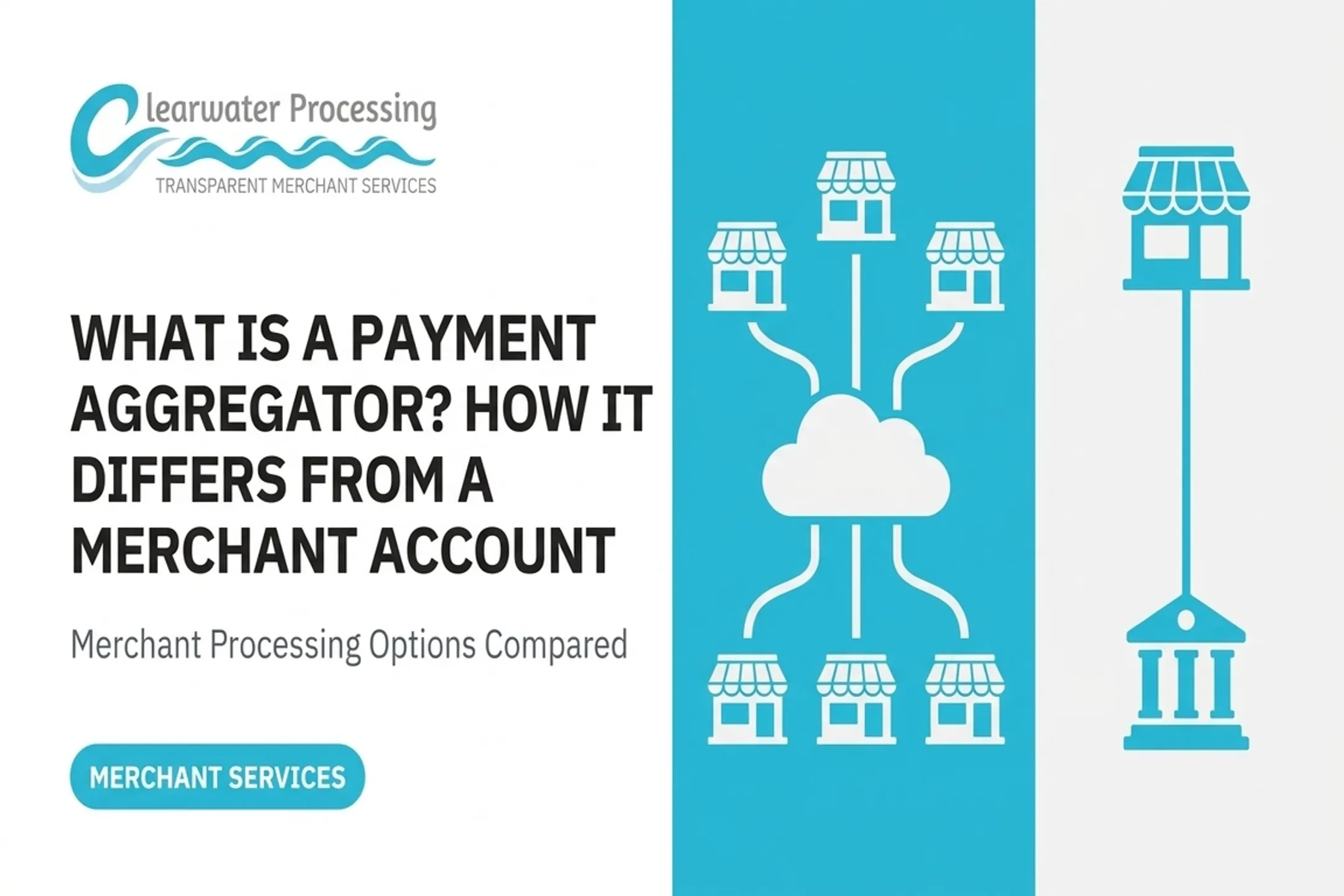
These platforms process payments through a shared (aggregated) merchant account rather than a dedicated one set up just for your business, so compare their account control, funding and support terms against a dedicated merchant account. For how these platforms operate, see the pros and cons of payment aggregators like Stripe, Square and PayPal and how a direct merchant account compares with a payment aggregator. Clearwater Processing sets up a dedicated merchant account in your business's name instead.