Card acceptance is now standard practice. 79% of small businesses accept at least one form of card payment, according to the Federal Reserve's 2024 Report on Payments. That convenience has a cost, and many owners wonder if a credit card surcharge can help recover it.
Here's the catch: a surcharge isn't a fee you can simply tack on. It's governed by federal and state law, card-network rules, your merchant agreement, and disclosure requirements that vary by state.
This guide covers what a surcharge actually is, the rules you need to follow, how to communicate it to customers, the steps for compliant implementation, and alternatives worth considering before you pass any cost along.
Key Takeaways
- Apply surcharges only to eligible credit transactions—never debit or prepaid cards.
- Layer compliance across federal and state law, card-network rules, your processor, and your industry.
- Disclose the fee before payment and show it as a separate line item on the receipt.
- Run a statement analysis first; you may recover costs without surcharging.
What Is a Credit Card Surcharge?
A credit card surcharge is an added charge applied when a customer pays with a credit card, meant to offset some or all of your card-acceptance costs. Visa and Mastercard both define it the same way: an extra fee added to the bill specifically for credit card use.
Card acceptance costs come from several places, not just one line item:
- Interchange — paid to the card-issuing bank
- Assessments — network fees charged by Visa, Mastercard, and others
- Processor fees — what your processor charges on top of interchange
- Gateway and equipment fees — for online checkout or terminal hardware
- Account fees — monthly or annual charges from your provider
A surcharge should reflect these real costs, not generate automatic profit.
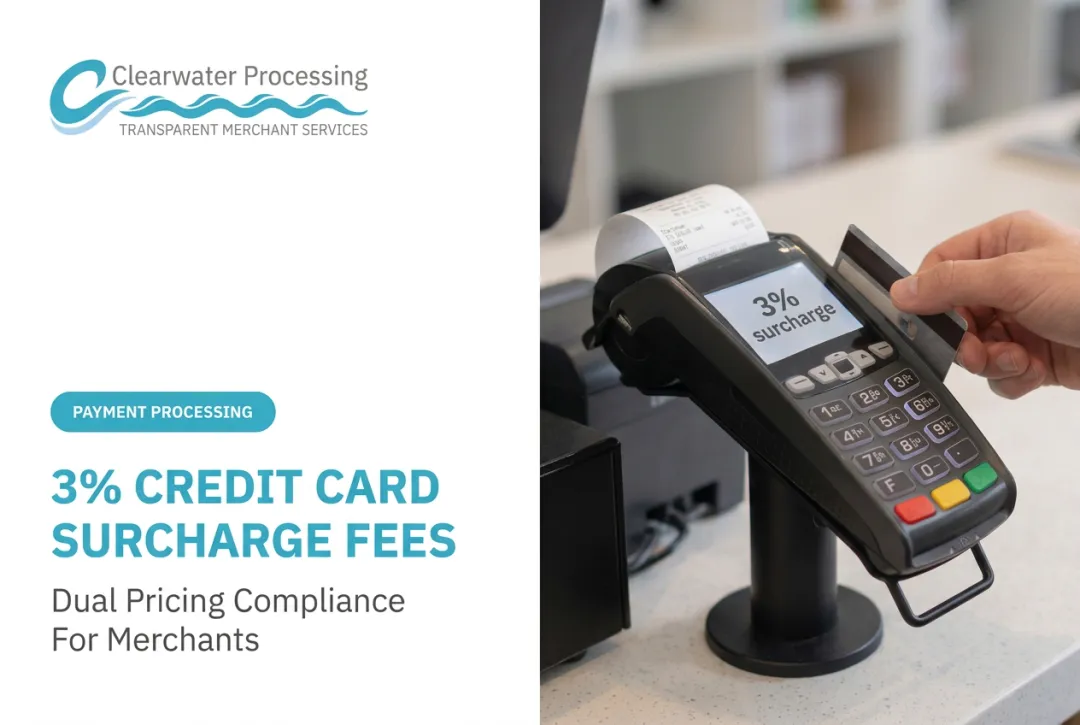
Here's a simple example: a customer's cart totals $100. Your business applies a 3% surcharge for credit card payment. That's $3 added to the bill, for a total of $103.
The surcharge is calculated on the original $100, and it must appear separately from the purchase price on the receipt.
Surcharges can apply to in-person purchases, online checkouts, phone orders, keyed-entry transactions, and invoices — but only where your payment setup and the applicable rules actually allow it.
Surcharge vs. Cash Discount vs. Convenience Fee
These three terms get mixed up constantly, and misusing them creates compliance risk.
- Surcharge: Adds an amount to the standard price when a customer uses a credit card.
- Cash discount: Reduces the price for customers paying with cash or another lower-cost method. The "regular" price must be posted as the credit price, with cash customers getting the discount — not the other way around.
- Convenience fee: Tied to a specific alternative payment channel (like paying by phone instead of in person), not simply to choosing a credit card. Convenience fees are typically flat amounts, not a percentage.
Don't call a credit card fee a "cash discount" unless your pricing and signage genuinely meet cash-discount structuring requirements. Regulators and card networks treat mislabeling as a real compliance problem, not a technicality.
Why Do Businesses Consider Surcharging?
The appeal is straightforward: recover processing costs, protect margins, and avoid raising prices across the board for every customer.
Surcharging can also nudge customers toward lower-cost payment methods, like debit or ACH. But it comes with tradeoffs:
- Some customers feel frustrated or blindsided at checkout
- Cart abandonment can increase, especially for price-sensitive purchases
- Staff need training to explain the fee and handle pushback
- Competitors who absorb processing costs may look more attractive
Whether surcharging makes sense depends on your margins, average ticket size, and how price-sensitive your customers are.
What Rules Must Businesses Follow?
Surcharging compliance works in layers. You need to check federal and state law, card-network rules, your merchant agreement, your processor's specific requirements, and any rules tied to your industry. Missing one layer can put you out of compliance even if you followed all the others correctly.
Rate limits vary by network and location. Visa caps U.S. surcharges at the lower of 3% or the merchant's actual credit card discount rate. Mastercard's U.S. cap is 3%, and merchants must also stay within their actual cost-of-acceptance limit.
Neither network permits surcharging debit or prepaid cards, including debit cards run as credit at checkout. American Express's public guidance states that surcharging isn't applicable for card payments made in the U.S.
Both major networks also require advance notice before you launch a surcharge program (generally at least 30 days to your acquirer and, for Mastercard, to the network itself).
State law adds another layer entirely. Several states restrict or prohibit surcharging outright, and the details shift regularly:
- Connecticut prohibits charging more for one payment type over another
- Massachusetts bars surcharges on credit card use under state law
- Maine prohibits credit or debit surcharges by private sellers
- New York permits surcharging only up to actual processing cost, with strict price-display rules
- New Jersey requires advance notice at entry, point of sale, and online checkout
- Oklahoma repealed its surcharge prohibition in 2025, changing the landscape there
If you operate in multiple states, review the rules for every location and transaction channel individually. One nationwide policy rarely covers you everywhere.
How Must Businesses Disclose a Surcharge?
Disclosure isn't optional, and it isn't just about the receipt. Customers need to see the surcharge before they complete payment.
That means:
- Signage at entry for physical locations, stating the surcharge applies to credit cards
- Clear checkout language online, before the customer submits payment
- Invoice or phone-payment disclosure when payment isn't collected in person
- A separate, labeled line item on the receipt — never folded into the product price
New York's rules go further: a receipt-only disclosure isn't enough. The higher, credit-card-inclusive price must be posted before purchase, with signage at both the item and the register.
Keep the language plain: name the payment method the surcharge applies to, the rate or amount, and the reason for it. Don't imply every payment type carries the fee when only credit cards do.
What Other Compliance Controls Matter?
Beyond rate limits and disclosure, a few operational pieces round out a compliant program.
- PCI DSS: Applies whether you surcharge or not. Store card data only in approved systems—never spreadsheets, email, or paper files.
- Refunds: Credit the surcharge back with the purchase on a full refund, and proportionally on a partial refund.
- Noncompliance risk: Improper surcharging can trigger disputes, chargebacks, network penalties, and processor action. Visa has stated that acquirers of noncompliant merchants may face immediate fines.
Before you launch, confirm both network rules and state law on their own. Passing one checklist does not satisfy the other.

How Should a Business Decide Whether and How to Implement a Surcharge?
Before adding a surcharge, look at your own numbers. Pull your processing statements and review:
- Average ticket size and transaction volume
- Card mix (how much volume is credit vs. debit)
- Current margins and refund frequency
- Customer payment preferences
Weigh expected cost recovery against the downsides:
- Slower checkout
- More customer complaints
- Extra reconciliation work for your team
Your business model shapes the tradeoff. A high-traffic retail shop faces different pressure than an ecommerce seller, a contractor collecting on-site deposits, or a subscription business on monthly billing. For subscription businesses, automatic updating of customers' expiring cards also keeps those monthly charges from failing.
High-ticket merchants and B2B distributors often have more room for a percentage-based fee than low-ticket shops. If trust and convenience anchor your customer relationships, check competitors first: a surcharge can work against you.
If you decide to move forward, test it on a limited, fully compliant basis first. Track payment-method mix, complaints, and chargebacks before rolling it out further.
A statement review can surface savings before you surcharge at all. Clearwater Processing's merchant statement analysis reviews statements from local banks and national processors, flagging confusing line items and unnecessary fees. Clients see 10%–30% savings on average, sometimes enough to close the gap without a customer-facing fee.

What Should a Compliant Implementation Process Include?
If you've done the analysis and still want to surcharge, build the program in this order:
- Confirm rules for every state and channel where you operate
- Document your rate, excluded card types, disclosure wording, and refund treatment
- Configure payment tools (hardware, gateway, invoicing, virtual terminal, recurring billing) so the surcharge applies only to eligible credit transactions
- Complete network and processor notifications before launch, and keep confirmation on file
- Update disclosures on signage, website, checkout, invoices, phone scripts, and receipts
- Train staff to explain the fee, spot credit vs. debit, and escalate uncertain cases
Review the whole program periodically. Processing costs, card-network rules, and state laws all shift over time.
How Can a Payment Processor Support Implementation?
A processor can help configure surcharge settings, exclude debit and prepaid cards automatically, adjust receipt language, and handle required notices. You still own legal suitability in every jurisdiction where you sell.
Whichever processor you choose, ask directly:
- Does it support your specific POS, gateway, invoicing, and accounting integrations?
- How does it handle updates when card-network or state rules change?
- Can it exclude debit and prepaid cards automatically, not just in theory?
How Clearwater Processing Can Help
Clearwater Processing offers tailored processing environments for terminals, ecommerce gateways, and back-office billing, along with comprehensive reporting. PCI compliance support comes backed by $100,000 breach protection insurance. Each client also gets a dedicated representative's personal cell number, with 24/7/365 U.S.-based backend support behind them.

What Are the Alternatives to Credit Card Surcharging?
Surcharging isn't the only way to protect your margins. These alternatives are often simpler to run—or pair well with lower processing rates.
- Statement analysis or switching processors: A statement review can show you're paying more than necessary. Clearwater Processing's statement analysis alone has uncovered 10%–30% average savings for clients without changing customer pricing.
- Cash discount programs: Lower the price for cash or debit instead of adding a credit card fee, but only if the program is structured and displayed correctly.
- ACH or bank payments: Lower cost than cards; strong fit for B2B invoicing or recurring billing when customers will switch.
- Built-in pricing: Fold acceptance costs into your regular prices instead of itemizing them at checkout.
- Minimum purchase amounts: Allowed in many states for card transactions, though rules vary by state.
The right mix depends on your margins, average ticket size, and how much compliance work you want to carry. For many merchants, better processing rates plus selective cash-discount or ACH options beat surcharging alone and create less checkout friction.
Frequently Asked Questions
Is there a surcharge on credit card payments?
Yes. Some businesses add one, but whether they can and how much depends on state law, card network rules, processor requirements, and advance disclosure. It's never automatic or universal.
Why am I charged extra for using a credit card?
The business may be passing along part of its credit card acceptance costs. A compliant merchant will clearly identify that charge before you pay and again on your receipt.
What is a 3% surcharge on $500?
A 3% surcharge on $500 equals $15, bringing the total to $515. This only applies if the 3% rate is lawful in that state, within the card network's cap, and properly disclosed beforehand.
How can I avoid credit card surcharges?
Paying with cash, check, ACH, or an eligible debit card typically avoids the fee, since surcharges apply only to credit transactions. Available options vary by business, so ask before you pay.
Is it legal to add a surcharge for using a credit card?
Yes. Surcharging is permitted in many U.S. states but restricted or banned in others, including Connecticut and Massachusetts. It's also subject to card network rate caps, disclosure rules, and processor requirements.
Is it legal to charge a surcharge on debit card transactions?
No. Both Visa and Mastercard prohibit surcharging debit and prepaid cards, including debit cards processed as credit. Verify current rules before setting up your payment system.