Introduction
If you've started shopping for a way to accept cards, you've probably seen "payment processor" and "payment facilitator" used almost interchangeably. Behind the payment facilitator vs payment processor question is a more practical decision: do you open your own merchant account with a direct merchant services provider, or sign up as a sub-merchant with a payment aggregator? Picking the wrong one can mean slower funding, surprise fees, or an account that gets frozen when you least expect it.
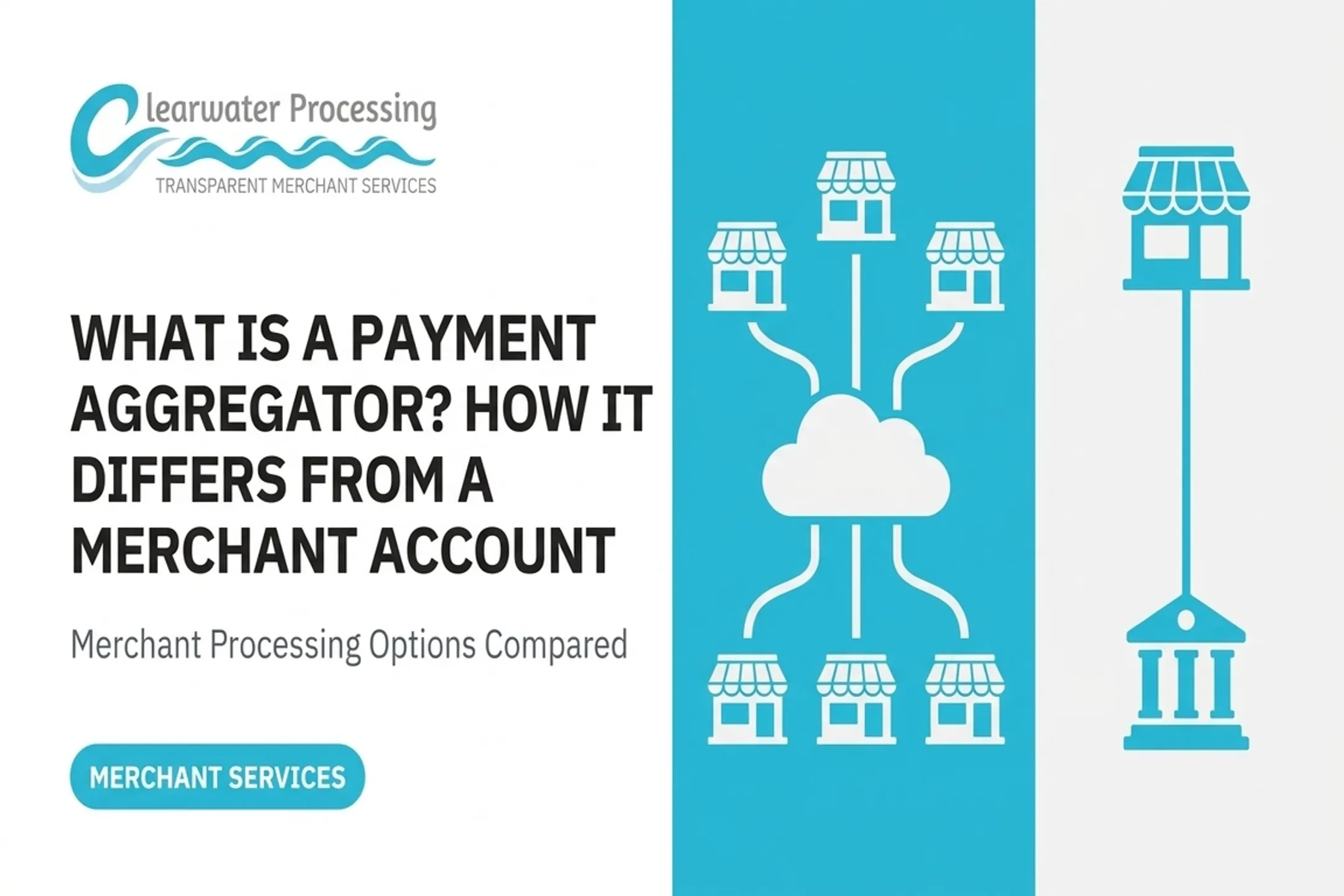
A payment aggregator is a third-party service provider (like Stripe, PayPal, or Square) that lets you accept payments without your own merchant account. You operate as a sub-merchant under the aggregator's master account. That makes setup fast, but you don't control the relationship, and you must abide by the aggregator's rules and regulations, which are often much more stringent than the Visa, Mastercard, and American Express rules and regulations. Payment facilitators (PayFacs) use this same aggregator model. A direct merchant services provider works differently: it sets your business up with its own merchant account through an acquiring bank, so the account and the relationship belong to you. For more background, see the pros and cons of payment aggregators like Stripe, Square and PayPal.
This article compares a direct merchant services provider with a payment aggregator side by side, lays out the pros and cons of each, and walks through real business scenarios. It then explains how processors and PayFacs work behind the scenes and clarifies related terms like payment gateway, PSP, and merchant acquirer, so you can evaluate any provider's pitch with confidence.
Key Takeaways
- Direct merchant account: your business holds its own merchant account through a merchant services provider and follows card-network rules plus your merchant agreement.
- Payment aggregator (the PayFac model): you're a sub-merchant under the aggregator's master account. Setup is fast, but you don't control the relationship and must follow the aggregator's own rules, which are often stricter than Visa, Mastercard, and American Express rules.
- Aggregators suit startups and low-volume sellers that need speed; direct accounts suit established and growing businesses that want control, transparent fees, and a dedicated point of contact.
- Aggregator risk models can hold funds, add reserves, or close an account with limited notice.
- In the payment facilitator vs payment processor comparison, a processor moves and settles transactions in both models. What differs is who holds the merchant account.
- Compare total costs, refund treatment, funding terms, and contract conditions before switching providers.
Direct Merchant Services Provider vs Payment Aggregator: Quick Comparison
Both models get you accepting cards. They differ in who holds the merchant account, whose rules you follow, how fast you're approved, and who you call when something goes wrong.
| Dimension | Direct Merchant Services Provider | Payment Aggregator (PayFac) |
|---|---|---|
| Merchant account | Your business holds its own merchant account, underwritten by the processor or acquiring bank | Your business operates as a sub-merchant under the aggregator's master account |
| Control of the relationship | The account and provider relationship are yours | The aggregator controls the account and the relationship |
| Rules you follow | Visa, Mastercard, and American Express network rules plus your merchant agreement | Card-network rules plus the aggregator's own terms, which are often more stringent |
| Onboarding | Detailed application and underwriting; slower but more tailored | Approval can happen during signup, still subject to verification |
| Pricing | Itemized interchange and processor fees | Bundled flat rates with little customization |
| Refunds | Varies by provider; Clearwater returns the interchange paid on Visa and Mastercard refunds | Original processing fees are often not returned |
| Holds and reserves | Set out in your merchant agreement | Aggregator risk models can hold funds, add reserves, or close accounts with limited notice |
| Risk & compliance | Merchant typically retains PCI obligations, fraud controls, and dispute responses, with help from the provider | Aggregator monitors sub-merchants and coordinates chargebacks |
| Support | Can include a dedicated representative who knows your account | Typically shared across a large sub-merchant portfolio |
| Best fit | Established or growing merchants that want control and transparent costs | Startups, occasional sellers, and platforms that need speed |
Direct Merchant Services Provider vs Payment Aggregator: Pros and Cons
"Payment aggregator" and "payment facilitator" are often used interchangeably because both describe the same sub-merchant model, so the pros and cons below apply to PayFac accounts too.
Payment Aggregator Pros
- Fast setup: approval can happen during signup, without a separate merchant-account application
- Simple pricing: bundled flat rates are easy to understand at low volume
- Low commitment: useful for testing a new product or handling occasional sales
Payment Aggregator Cons
- You don't control the relationship: your sub-merchant account sits under someone else's master account
- Stricter rules: you must follow the aggregator's own terms, which are often more stringent than Visa, Mastercard, and American Express rules
- Account holds and reserves: the aggregator's risk models can hold funds, add reserves, or close an account with limited notice
- Costs that grow with you: bundled rates can become expensive as volume rises, and on standard pricing, Stripe's own published pricing states that the payment processing fees from the original transaction are not returned when you issue a refund, while Clearwater returns the interchange merchants paid when a refund on Visa and Mastercard is issued
- Shared support: help is typically spread across a large sub-merchant portfolio rather than assigned to one person who knows your business
Before you commit to an aggregator account, see the pros and cons of payment aggregators like Stripe, Square and PayPal in more detail.
Direct Merchant Account Pros
- You own the account: the merchant account and provider relationship are yours, and the rules are the card networks' rules plus your merchant agreement
- Transparent costs: your statement itemizes interchange and processor fees instead of hiding them in one bundled rate
- Tailored tools: gateways, virtual terminals, EMV terminals, recurring billing, and reporting can be set up around how you actually sell
- A real point of contact: many direct providers assign a representative who knows your account
Direct Merchant Account Cons
- Longer approval: a full application and underwriting review takes longer than aggregator signup
- More paperwork: expect to provide business details, financials, and processing history
- Contract terms vary: review contract length and cancellation terms before you sign
- More ownership of obligations: PCI compliance and dispute responses stay with the business, though many providers help
Where Clearwater Processing Fits
Clearwater Processing is a direct merchant services provider. Each merchant gets its own merchant account and a single point of contact: a dedicated representative with industry experience whose direct cell phone number you have, not a chat box, backed by 24/7/365 US-based support. When you refund a Visa or Mastercard sale, Clearwater returns the interchange you paid on that transaction.
Clearwater builds tailored processing environments around ecommerce gateways, back-office recurring billing, standalone EMV terminals, and reporting. Its recurring billing includes automatic customer card updating, so cards that are about to expire are refreshed automatically, which saves time and retains subscription revenue.
Behind the Scenes: Payment Facilitator vs Payment Processor Roles
The aggregator-or-direct decision sits on top of two infrastructure roles. A payment processor moves transactions in both models; a payment facilitator is the entity that runs the aggregator model. Plenty of providers blend these roles, so verify in writing whether your prospective provider is contractually the processor, the PayFac, or both.
What Is a Payment Processor?
A payment processor is the infrastructure layer that transmits transaction data between the merchant's gateway or point-of-sale system, the card networks, the issuing bank, and the acquiring bank. Its job is to get a card transaction authorized, captured, settled, and funded.
How a transaction actually moves:
- Initiation – The customer swipes, dips, taps, or keys in their card.
- Encryption and transmission – The processor encrypts the data and sends it to the card network.
- Authorization – The issuing bank approves or declines based on funds and fraud checks.
- Capture and settlement – Approved sales are batched and sent for clearing.
- Funding – The acquiring bank credits the merchant's account, net of fees.
- Refunds or chargebacks – Handled after the fact if a dispute arises.

Processors handle transaction routing, payment-method connectivity, security controls, reporting, and integrations with terminals, gateways, and accounting software. They typically don't own the merchant relationship or provide the merchant account itself; those functions belong to the acquiring bank in a direct setup, or to the PayFac in an aggregator setup.
Visa's own merchant-success data shows U.S. authorization approval rates below 87% across its VisaNet network from April 2023 to March 2025, a reminder in Visa's merchant success report that authorization reliability isn't automatic. It depends on the processor's connectivity and fraud tools.
What Is a Payment Facilitator?
A payment facilitator, or PayFac, is an approved entity that lets businesses accept card payments as sub-merchants under the PayFac's own master merchant account. Instead of applying for your own account, you're onboarded through the PayFac's system, subject to its underwriting and monitoring.
A PayFac is distinct from a payment gateway (the technology that transmits payment data) and from the broader term PSP, which can describe a mix of services depending on the provider.
The appeal is centralization. One provider handles merchant verification, account setup, payment operations, and payout coordination, which can shorten the time between signing up and processing your first transaction. According to Mastercard's 2025 analysis of PayFac-as-a-Service, this model can reduce onboarding from weeks to minutes for individual sub-merchants. It can also cut time-to-market for new PayFac programs from months to weeks, though results vary by provider and risk profile.

What a PayFac typically manages:
- KYB/merchant verification before activating a sub-merchant account
- Underwriting and ongoing transaction monitoring for fraud signals
- Compliance oversight, including reserve requirements where applicable
- Dispute and chargeback coordination across its sub-merchant portfolio
- Sub-merchant funding and payout scheduling
Faster setup and one-stop onboarding often come at the cost of less control. Businesses may have limited say over underwriting decisions, pricing structure, payout timing, reserve policies, or account restrictions, and they agree to the PayFac's own terms on top of card-network rules. PayFac arrangements tend to fit startups, seasonal sellers, and marketplaces or SaaS platforms that onboard many business users. Recurring-billing operators on any model should confirm whether automatic card updating is included; without it, expired cards turn into failed charges and manual follow-up.
Which Option Is Better for Your Business? Real-World Scenarios
There's no universal winner here. The right fit depends on volume, timeline, risk tolerance, and how much administrative work you want to own.
Consider a direct merchant account if:
- You have an established processing history and meaningful monthly volume
- Your payment flows are complex or require custom integrations
- You want direct visibility into interchange and processor fees, and an account relationship you control
- You'd rather work with a dedicated representative than a shared support queue
Consider a payment aggregator (PayFac) account if:
- You need to start accepting payments quickly
- You'd rather outsource underwriting, risk, and payout administration, and accept the aggregator's rules in exchange
- Your volume is low or occasional
The right answer can also shift over time. A business might start with an aggregator for speed, then move toward its own merchant account as volume and reporting needs grow.
Visa's own rules illustrate this: once a sponsored merchant's annual Visa sales exceed $1 million, the acquirer must be added directly to that merchant's acceptance agreement, even though the PayFac can continue servicing the account. (Visa, Beyond the Acquirer)
Two Quick Scenarios
- An independent retail shop swiping cards all day cares most about reliable EMV hardware, a statement it can actually read, and someone to call. A direct merchant account with transparent reporting fits better here than an aggregator account.
- A software platform onboarding hundreds of sub-merchants needs embedded payments, so the PayFac (aggregator) model fits that use case more naturally. Software companies that would rather not run their own PayFac program can offer processing to the businesses they serve through a payment processing partner program for SaaS companies.

Provider Evaluation Checklist
Before signing anything, ask for clarity on:
- Effective rate and all fee line items, not just the headline rate
- Contract length and cancellation terms
- Reserve policies and funding timelines
- Chargeback support and dispute process
- PCI assistance and fraud tools included
- Payment-method coverage and integration options
- Reporting access and data ownership
- Whose rules govern account holds, reserves, and termination
- Who your point of contact is, and whether you can reach a real person with industry experience
If you're an established merchant staring at unexplained fees or shrinking margins, a merchant statement analysis can help. Clearwater Processing reviews statements line by line, flags confusing charges, and compares your current setup against alternatives.
Clearwater Processing is currently showing clients 10%–30% savings on average. Review your current statement and payment workflow with a merchant-services representative before you switch providers or sign anything new.
Conclusion
Behind the payment facilitator vs payment processor question is a choice about ownership. A payment aggregator, the model PayFacs use, wins on setup speed, but you're a sub-merchant under someone else's master account and subject to its often stricter rules. A direct merchant services provider gives you your own merchant account, card-network rules instead of a platform's terms, itemized interchange and processor fees, and a dedicated point of contact.
In both models a processor moves and settles your transaction data. The difference is who holds the account and who controls the relationship.
Choose based on how much control, speed, and support your business actually needs, then verify the provider's exact role in writing before you sign.
Frequently Asked Questions
What is the difference between a direct merchant services provider and a payment aggregator?
A direct merchant services provider sets your business up with its own merchant account, so you control the relationship and follow card-network rules plus your merchant agreement. A payment aggregator lets you accept payments as a sub-merchant under its master account, which is faster to set up but means following the aggregator's own rules, which are often more stringent.
What is the difference between a payment facilitator and a payment processor?
A processor handles the technical movement and settlement of transactions. A PayFac onboards businesses as sub-merchants under its own master account and typically manages underwriting, compliance, and payouts on top of that.
What is a payment facilitator?
A PayFac is an entity that lets businesses accept card payments as sub-merchants under its master merchant account, handling onboarding, risk monitoring, and related payment administration.
What is a payment aggregator?
A payment aggregator is a third-party service provider that lets you accept payments without your own merchant account. You operate as a sub-merchant under the aggregator's master account and must follow the aggregator's rules, which are often more stringent than card-network rules.
Is a payment aggregator account the same as a direct merchant account?
No. With an aggregator you are a sub-merchant on the aggregator's master account. With a direct merchant account, your business holds its own account through an acquiring bank and controls the relationship.
Can a payment aggregator hold my funds?
Yes. Aggregators can place holds or reserves on sub-merchant funds, or close an account, based on their own risk policies. Review those terms before you sign up.
What is a payment processor?
A payment processor routes transaction data, secures authorization from the issuing bank, and supports settlement between merchants, banks, and card networks.
What is the difference between a PayFac and a PSP?
PayFac describes a specific sub-merchant, master-account model. PSP is a broader term that can include processing, gateway, acquiring, fraud, or payout services depending on the provider.
What is the difference between a payment processor and a merchant acquirer?
The processor supplies the transaction-processing infrastructure. The acquiring bank holds the merchant-account relationship and contractual responsibility. One company can offer both functions.
What is the difference between a payment provider and a payment gateway?
A payment provider is a broad service-provider category covering processors, PayFacs, and PSPs. A gateway is specifically the technology that captures and transmits payment data from checkout to the processing network.