This guide is for business owners, finance leaders, and merchants across retail, B2B, and ecommerce who depend on card transactions daily. Understanding acquiring isn't optional trivia. It directly affects your cash flow, your compliance obligations, and how exposed you are to fraud and disputes.
Card payments happen instantly at checkout, but the machinery behind that speed is widely misunderstood. This article breaks down what merchant acquiring actually is, how money travels through the card network lifecycle, the factors that shape processing costs and speed, what is not a merchant acquirer (payment aggregators), the pros and cons of Stripe, Square, PayPal, Helcim and Stax, who keeps the fee when you refund a customer, and how to evaluate which acquiring model fits your business.
Key Takeaways
- Merchant acquirers connect businesses, card networks, and issuing banks to settle transactions securely.
- Acquirers settle funds and underwrite risk; processors route data; issuers manage cardholder credit.
- Every card payment moves through authorization, clearing/settlement, then merchant funding.
- Payment aggregators such as Stripe, Square, and PayPal are not merchant acquirers: you become a sub-merchant under their master account and their rules. This guide lays out the pros and cons of Stripe, Square, PayPal, Helcim and Stax.
- Refunds are where the difference shows: Clearwater Processing returns the interchange merchants paid when a refund on Visa and Mastercard is issued, while Stripe's own published pricing says its processing fees on the original charge are not returned.
- Fee transparency, PCI compliance, a direct merchant relationship, and a real person to call protect your bottom line.
What Is the Merchant Acquiring Process?
Merchant acquiring is the service an acquiring bank or merchant services provider provides so a business can operate with a functioning merchant account. The acquirer underwrites transaction risk, sponsors the merchant's ability to accept cards, and collects funds from cardholders' banks on the merchant's behalf.
In plain terms, the process converts a digital card authorization into settled cash sitting in your operational bank account. It's the difference between a customer's bank saying "yes, this purchase is approved" and your business actually having that money to pay rent, payroll, or suppliers.
Acquiring is easy to mix up with three neighboring roles in the payments stack:
- Card issuing manages the consumer's credit line, sets their spending limit, and approves or declines purchases from the buyer's side of the transaction.
- Payment gateways simply transmit encrypted transaction data from checkout to the processor. They don't hold funds, underwrite risk, or maintain your merchant account.
- Payment aggregators (PayFacs) board many businesses under one shared master account. They are not your acquirer: they sit between you and the acquirer and apply their own risk rules. The aggregator section below covers the trade-offs.
Visa's own guidance confirms this structure: merchants contract with an acquirer either directly or through a sponsored payment facilitator, and that acquirer remains responsible for merchant oversight throughout the relationship. Clearwater Processing's Credit Card Processing & Merchant Accounts service sets up that acquirer-backed merchant account around how your business actually takes payments—not a generic, template configuration.
Why the Merchant Acquiring Process Is Used in Modern Commerce
Cash is no longer king. According to the Federal Reserve's 2025 Diary of Consumer Payment Choice, credit cards accounted for 35% of U.S. consumer payments by number in 2024, debit cards 30%, and cash just 14%.

That shift means businesses without a reliable acquiring relationship are locking themselves out of the majority of consumer spending.
Modern business operations demand more than just "accepting cards." They need:
- Transaction speed: approvals in seconds, not minutes
- Fraud mitigation: real-time scoring before funds ever move
- Chargeback defense: protection when a disputed sale threatens revenue
- Reliable cash flow: predictable, timely deposits
When acquiring channels fail or get misconfigured, the consequences show up fast: held batches, frozen merchant accounts, spiking dispute ratios, and sudden cash-flow gaps that can stall payroll.
This is largely an operational and card-brand necessity rather than a government regulatory mandate. Visa, Mastercard, American Express, and Discover each set their own acceptance and acquirer sponsorship rules, and noncompliance can mean losing acceptance privileges entirely.
Where acquiring shows up day-to-day:
- Physical EMV point-of-sale terminals and mobile card readers
- Virtual terminals for phone or email invoicing
- Ecommerce gateways for online checkout
- Recurring billing runs for subscriptions and service contracts
Clearwater Processing supports this across formats. Its stand-alone EMV terminals, virtual terminal, ecommerce gateway, and recurring billing solutions all connect back to the same underlying acquiring relationship, whether a customer taps a card in a showroom or a SaaS subscription bills automatically each month. For recurring billing, Clearwater can also automatically update customers' cards that are about to expire, which saves time and retains revenue without chasing customers for new card details.
How the Merchant Acquiring Process Works (Conceptual Flow)
An electronic transaction travels through several financial institutions before it ever becomes usable cash. The process starts with inputs like cardholder credentials, transaction metadata, the merchant identification number (MID), and terminal or gateway payloads.
Behind the scenes, several things happen almost simultaneously:
- Identity verification
- Anti-fraud scoring
- Balance checks
- Interchange fee calculation
- Interbank netting
Card brand operating rules, underwriting risk limits, and automated batch controls govern every step. By the end, the cardholder's account is debited, interchange and processor fees are deducted, and net proceeds land with the merchant.
That flow breaks into three distinct stages.
Step 1: Transaction Authorization
The payment gateway captures encrypted card data and passes it to the processor and acquirer. From there, it routes across the card brand network to the issuing bank, which checks available funds and fraud signals before approving or declining. This entire exchange happens in seconds, but approval alone doesn't mean funds have moved yet.
Step 2: Clearing and Settlement
At the end of the business day, merchants close and submit their batch of authorized transactions. The acquirer delivers clearing files through the card network to collect gross funds from each issuing bank involved. This is where individual authorizations get bundled and reconciled at scale.
Step 3: Funding and Reconciliation
Finally, the acquiring bank deducts interchange and processing fees before depositing net proceeds into the merchant's operating account.
Standard small-business funding typically takes one to five business days, according to the U.S. Chamber of Commerce's guide to credit card processing. That timeline depends heavily on the processor's funding schedule.

Key Factors That Affect the Merchant Acquiring Process
Not every transaction costs the same or moves at the same speed. Several variables shape acquiring outcomes:
- Card type and entry method: Card-present EMV chip transactions typically qualify for better rates than card-not-present, keyed-entry sales. Debit differs from commercial or corporate credit cards.
- Merchant category code (MCC) and risk profile: Some MCCs, such as certain gambling codes, get flagged for additional underwriting scrutiny and higher chargeback monitoring.
- Gateway and hardware certification: Terminal certifications and ERP or accounting software integrations determine how smoothly transactions flow end to end.
- Volume, ticket size, and batch timing: Larger, more consistent volume and prompt batch submission often improve interchange qualification and funding turnaround.
- PCI-DSS compliance level: Under Visa's Account Information Security program, your 12-month transaction volume determines your required validation level.
Interchange itself is non-negotiable. According to Visa's U.S. interchange reimbursement fee schedule, rates vary by card product and transaction category, and merchants pay a merchant discount to their acquirer rather than paying interchange directly. That distinction matters when comparing pricing between providers.
PCI compliance isn't optional either. Clearwater Processing builds it into every merchant portfolio, along with $100,000 breach protection insurance. Those layers cut exposure when fraud attempts occur.
What Is Not a Merchant Acquirer: Payment Aggregators
One of the most common points of confusion is the difference between a merchant acquirer and a payment aggregator, also called a payment facilitator or PayFac. Many businesses believe they have a merchant account when they actually have an aggregator account, and the difference usually shows up at the worst possible moment: when funds are held or an account is closed.
A payment aggregator is a third-party service provider that lets you accept card payments without your own merchant account. It is not your acquirer. It resells access to merchant acquirer services: it holds one master merchant account with an acquiring bank and boards thousands of businesses underneath it as sub-merchants. Instead of receiving your own Merchant ID (MID) after individual underwriting, your business operates under the aggregator's master account. The acquirer still sits behind the transaction, but your contract, your funding, and your account decisions run through the aggregator.
That setup is fast, but you don't control the relationship. As a sub-merchant, you must abide by the aggregator's own rules and acceptable-use policies, which are often more stringent than the rules Visa, Mastercard, and American Express set for merchants. The aggregator decides what counts as unusual activity, when to hold funds, and whether to keep your account open.
Who the Payment Aggregators Are
The names merchants most often compare here are Stripe, Square, and PayPal, which board most businesses as sub-merchants through a quick online signup. Helcim and Stax are frequently compared alongside them as app-style alternatives to a traditional merchant account. Account structures and pricing differ by provider and product, so the only reliable way to know what you are signing up for is to ask each provider directly whether you will receive your own MID and individual underwriting, and whose rules will govern holds, reserves, and account closures. The provider-by-provider pros and cons comparison below covers the problems merchants most often report with each one, and our guide to the pros and cons of flat-rate credit card processing explains what blended pricing means for your costs.
Pros of Payment Aggregators
- Fast signup: Accounts can often be opened online in minutes with minimal paperwork.
- Simple pricing to start: Many aggregators use a single flat rate that is easy to understand at low volume.
- Low commitment: Typically no long application process, which suits pop-up sellers, side businesses, and very low-volume merchants.
- Bundled tools: Checkout pages, invoicing, and basic reporting often come built in.
Cons of Payment Aggregators
- You don't control the relationship: Your account sits under the aggregator's master account, so the aggregator, not you, sets the terms and can change them.
- Stricter rules than the card brands: Aggregators layer their own restricted-business lists, risk thresholds, and terms of service on top of Visa, Mastercard, and American Express rules, and those extra rules are often the stricter ones.
- Holds and freezes: Because risk is managed across a shared account, automated rules can pause payouts, hold funds, or freeze an account when sales patterns change, such as a large order or a seasonal spike.
- Sudden terminations: Accounts can be closed under the aggregator's own terms, sometimes with funds held for a period afterward.
- Rolling reserves and funding delays: A percentage of sales may be withheld, or payouts may slow down while a review takes place.
- Rising costs at scale: A flat rate that is convenient at low volume often costs more than interchange-plus pricing as monthly volume grows.
- Limited pricing visibility: Blended rates hide the split between interchange, network assessments, and processor fees.
- Limited human support: Many merchants report relying on help articles, email tickets, or chat bots rather than a dedicated representative who knows their account.
Dedicated Merchant Acquiring vs. Payment Aggregator
| Factor | Dedicated merchant account (acquirer-backed) | Payment aggregator (PayFac) |
|---|---|---|
| Merchant ID | Your own unique MID | Shared master account; you are a sub-merchant |
| Underwriting | Individual underwriting up front | Light signup; risk reviewed after activity starts |
| Pricing model | Often interchange-plus or custom pricing | Often flat-rate or blended pricing |
| Funding | Set schedule, with next-day options from some providers | Varies; subject to holds and reserves under aggregator rules |
| Support | Often a dedicated representative | Often self-service, email, or chat |
| Account stability | Terms set in your merchant agreement | Subject to the aggregator's own risk policies |
| Rules you follow | Card brand rules (Visa, Mastercard, American Express) | Card brand rules plus the aggregator's own, often stricter, policies |
Neither model is wrong for every business. A weekend market vendor may be well served by an aggregator. A growing retailer, B2B supplier, or service business processing steady volume usually benefits from a dedicated merchant account with its own MID, underwriting that reflects how the business actually sells, and a person to call when something goes wrong. For a deeper side-by-side, see how a direct merchant account compares with a payment aggregator.
Pros and Cons of Stripe, Square, PayPal, Helcim and Stax
Stripe, Square, and PayPal board most businesses as sub-merchants under their own master accounts. Helcim and Stax are often compared alongside them as app-style alternatives to a traditional merchant account, although their account structures vary by product. The comparison below focuses on the problems merchants raise most often. It draws on each provider's own published pricing and on issues commonly reported by merchants. Pricing and terms change, so confirm current details in writing with any provider before you sign.
| Provider | Commonly cited pros | Problems commonly reported by merchants (and what to check) |
|---|---|---|
| Stripe | Fast online signup; developer-friendly APIs | Per Stripe's own published pricing, processing fees on the original charge are not returned when you refund on standard pricing. Add-on fees for Billing, Tax, international cards, and currency conversion stack on top of the 2.9% + 30¢ headline rate. Merchants commonly report payout holds, reserves, and account closures after automated risk reviews, and support that runs mostly through chat, email, and help articles. |
| Square | Quick setup; simple point-of-sale app and card readers | Merchants commonly report funds held or accounts deactivated after a risk review, often following a large or unusual sale. One flat rate applies across card types, so low-cost debit is priced the same as premium rewards or American Express cards. Square card readers are built for Square's own processing, so switching usually means replacing hardware. Many merchants report difficulty reaching a person who knows their account. |
| PayPal | A checkout button many shoppers recognize | Merchants commonly report payment holds and account limitations that restrict access to funds during a review. PayPal's published fee schedule adds charges for international payments and currency conversion. Merchants frequently describe support as hard to reach for urgent account issues. |
| Helcim | Published interchange-plus pricing | Like other online-signup providers, its own risk rules can lead to account reviews or held funds. Ask whether you get a dedicated representative with a direct phone line or rely on general support queues. |
| Stax | Subscription pricing built around a monthly membership fee | The monthly fee applies whether sales are high or low, which can cost lower-volume or seasonal businesses more. Review cancellation terms closely, and ask whether you get one named representative or a general support queue. |
The pattern across all five is the same: you don't control the relationship. The provider's own rules decide when funds are held, how much goes into reserve, and whether an account stays open, and those rules are often stricter than the Visa, Mastercard, and American Express rules a dedicated merchant account follows. When something goes wrong, merchants commonly report working through tickets and chat queues instead of calling one person who already knows their business.
Refunds: Who Keeps the Fee?
Refunds are where the difference between models shows up on your statement.
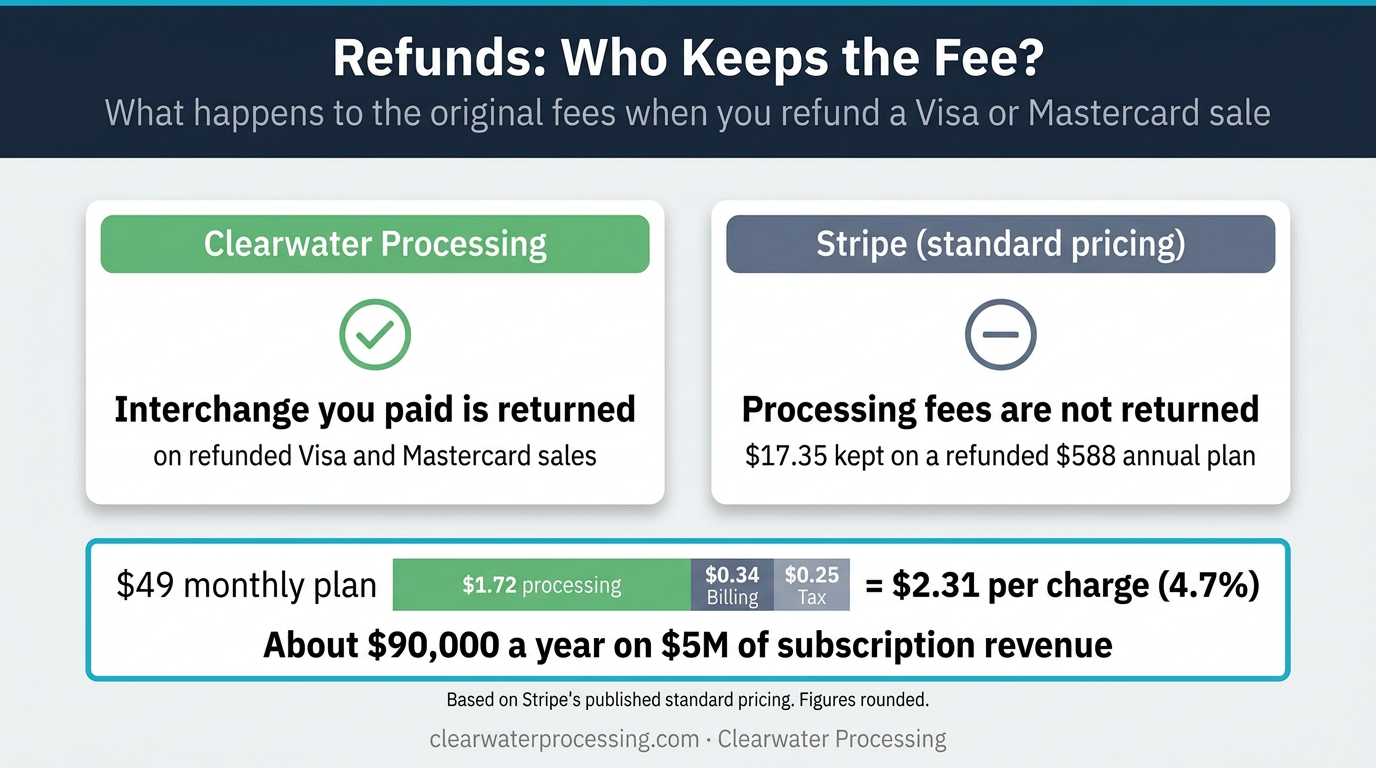
Clearwater Processing returns the interchange merchants paid when a refund on Visa and Mastercard is issued.
Refund a customer on Stripe and Stripe keeps its cut. That isn't an opinion. It is in Stripe's own pricing FAQ: on standard pricing, "the payment processing, Connect and currency conversion fees from the original transaction are not returned." Your customer gets their money back. Stripe keeps its fee.
| On a refunded sale | Clearwater Processing | Stripe (standard pricing) |
|---|---|---|
| Fees from the original Visa or Mastercard charge | The interchange the merchant paid is returned | Per Stripe's published pricing, processing, Connect, and currency conversion fees are not returned |
The Stacked Stripe Bill for Subscription Businesses
Now stack the bill the way most subscription companies actually run it. Per Stripe's own published pricing:
- 2.9% + 30¢ per domestic card charge
- 0.7% of Billing volume on pay-as-you-go Stripe Billing
- 0.5% per transaction for Stripe Tax on no-code integrations, wherever you're registered
- 1.5% more for international cards, plus 1% if currency conversion kicks in
| Fee on a $49 monthly plan | Approximate cost per charge |
|---|---|
| Card processing (2.9% + 30¢) | $1.72 |
| Stripe Billing (0.7%) | About 34¢ |
| Stripe Tax (0.5%) | About 25¢ |
| Total before international cards or disputes | Roughly $2.31 a charge, or 4.7% |
On $5M of subscription revenue at that price point, the gap between the 2.9% everyone quotes and what actually leaves your account is about $90,000 a year.
Then churn hits. Refund a $588 annual plan and the $17.35 in processing on the original charge stays with Stripe. Try to negotiate your way out with custom pricing and read the same page closely: Authorization Boost is "included" on standard pricing, but listed at 0.2% per successful online card transaction for accounts on custom payments pricing.
Figures are based on Stripe's published pricing at the time of writing and are rounded. Check Stripe's current pricing for your own account.
For subscription businesses, Clearwater Processing's recurring billing can also automatically update customers' cards that are about to expire, which saves time and retains revenue automatically.
How Clearwater Processing Compares
| Common pain point | Typical payment aggregator experience | Clearwater Processing |
|---|---|---|
| Account structure | Sub-merchant under the aggregator's master account | Your own acquirer-backed merchant account and MID, with individual underwriting |
| Fees on refunds | Stripe, per its published pricing, does not return processing fees on the original charge; check each provider's refund terms | Returns the interchange merchants paid when a refund on Visa and Mastercard is issued |
| Who you call | Chat, email tickets, and help articles are commonly reported | A dedicated representative with industry experience whose direct cell phone number you have, plus 24/7/365 US-based support |
| Pricing visibility | Blended flat rates plus add-on fees | Transparent pricing, with a merchant statement analysis that shows what you pay in each fee category |
| Funding | Subject to holds and reserves under the aggregator's own rules | Next-day funding |
| Recurring billing | Billing tools often priced as add-ons | Recurring billing with automatic updating of cards that are about to expire |
| Gateways and hardware | Often tied to the provider's own platform | Works with all major gateways, including Authorize.net, NMI, and FluidPay, plus virtual terminal and standalone EMV terminals |
Common Issues and Misconceptions in Merchant Acquiring
Confusion around acquiring costs businesses real money every year. Here are the misconceptions worth clearing up.
"Acquirers, processors, and gateways are the same thing." They're not. The acquirer maintains your merchant account and financial relationship, the processor routes transaction data, and the gateway simply bridges your checkout to that processor. Treating them as interchangeable makes it harder to diagnose problems when something breaks.
"All pricing models are basically equal." They aren't. The structure you pick changes what you can see—and what you overpay for:
- Flat-rate: Bundles interchange, network assessments, and processor fees into one blended number. Convenient, but opaque.
- Tiered: Sorts transactions into qualified, mid-qualified, and non-qualified buckets, often burying higher processor fees in the lower tiers.
- Interchange-plus: Itemizes actual interchange separately from the processor's fees. Usually the most transparent option.

"Authorization means the payment is final." It doesn't. An approved transaction remains subject to chargebacks, returns, and dispute windows well after settlement. Visa's own dispute rules describe specific windows, including a 120-day filing period with a 540-day outer limit for certain non-delivery scenarios — a reminder that "approved" and "final" are two different things.
Fit matters as much as price. Micro-merchants and short-term sellers sometimes start on other models, each with trade-offs:
- PayFac/aggregator model: Sub-merchants operate under a shared master account. It is quick to open for a one-weekend pop-up or a business without formal entity docs, but you are a sub-merchant subject to the aggregator's own holds, reserves, and account-closure rules (see the aggregator section above)
- Direct ACH: Often more efficient for large wholesale transfers
- Peer-to-peer: Fine for casual, low-stakes payments
The tell-tale signs a business has outgrown an aggregate processor are rising per-transaction costs, inconsistent funding schedules, or account holds that don't match actual sales volume. At that point, a dedicated acquiring setup with its own MID and underwriting usually means steadier funding and better rates.
How Clearwater Processing Can Help With Merchant Acquiring
Clearwater Processing's executives have provided merchant processing environments since 2003, and the company serves merchants in 32 states from locations in South Florida, New York City, and Arizona. Instead of boarding you as a sub-merchant inside someone else's master account, Clearwater sets up an acquirer-backed merchant account with its own MID and underwriting that reflects how your business actually sells. That gives you a direct merchant relationship, built around transparent pricing.
- A real person, not a chat box: a single point of contact, a dedicated representative with industry experience whose direct cell phone number you have.
- 24/7/365 US-based support: service centers based in Texas answer around the clock, every day of the year.
- Refunds that don't cost you twice: the interchange you paid comes back to you on Visa and Mastercard refunds.
- Pricing you can see: a merchant statement analysis that has shown clients 10%–30% savings on average when they suspected they were overpaying.
- Cash flow and security: next-day funding, PCI compliance solutions, and $100,000 breach protection insurance.
- Flexible acceptance: works with all major gateways, including Authorize.net, NMI, and FluidPay, plus a virtual terminal, standalone EMV terminals, and recurring billing with automatic card updating for cards that are about to expire.
- Help moving off an aggregator: processor switching and migration support, covered in our guide to switching merchant services.
Conclusion
Merchant acquiring is the mechanism that turns a card authorization into verified, funded business capital. Understanding how it works — authorization, clearing and settlement, then funding — gives business owners real leverage over cash flow, processing costs, and protection against disruptions.
Choosing an acquiring partner should match how your business actually takes payment, not sit as an afterthought. The providers that matter most are the ones that explain their pricing instead of burying it.
If you run on Stripe, Square, PayPal, Helcim, or Stax today, weigh the pros and cons above against what you actually pay, including the fees kept when you refund a customer, and against what happens when you need a person on the phone. A direct merchant relationship with Clearwater Processing means your own merchant account and a dedicated representative whose direct cell phone number you have, backed by 24/7/365 US-based support.
Frequently Asked Questions
What does a merchant acquirer do?
An acquirer maintains your merchant processing account, facilitates transaction authorization and settlement through the card networks, and deposits payment funds into your business bank account.
What is the difference between a merchant acquirer, an issuer, and a processor?
The acquirer is your business's financial institution, the issuer is the cardholder's bank that approves or declines purchases, and the processor is the technology layer that routes transaction data between all parties.
What are the four types of payment methods?
Most businesses rely on credit/debit cards, bank-to-bank transfers (ACH/wire), digital wallets and contactless payments, and cash or paper checks.
How long does it take for merchant acquiring funds to settle?
Standard funding usually takes one to five business days, depending on your processor's schedule. Some processors offer next-day or same-day options; Clearwater Processing’s next-day funding shortens that wait.
How do merchant acquiring fees work?
Fees break down into three parts: non-negotiable interchange paid to the issuing bank, a card network assessment fee, and the acquirer or processor fees charged by your provider. A merchant statement analysis shows exactly what you pay in each category.
What is the difference between a merchant acquirer and a payment facilitator (PayFac)?
A dedicated acquirer issues your business a unique Merchant ID with custom underwriting. A PayFac instead boards your business as a sub-merchant under its own shared master account. Stripe, Square, and PayPal are examples of this model (see the pros and cons comparison above). It is fast to set up, but you don't control the relationship: the aggregator applies its own rules, which are often stricter than card brand rules, and can hold funds or close accounts under them. Flat-rate pricing also often costs more as volume grows. If you are comparing providers, ask each one whether you will receive your own MID and individual underwriting.
Are Stripe, Square, and PayPal merchant acquirers?
No. They are payment aggregators (payment facilitators). They rely on acquiring banks behind the scenes and board your business as a sub-merchant under their own master account, so you follow their rules and risk policies rather than holding your own merchant account and MID. See the pros and cons of flat-rate processing for what their pricing model means for your costs.
Does Stripe return its processing fee when I refund a customer?
No. Per Stripe's own published pricing, on standard pricing "the payment processing, Connect and currency conversion fees from the original transaction are not returned." Refund a $588 annual plan and the $17.35 in processing on the original charge stays with Stripe. Clearwater Processing returns the interchange merchants paid when a refund on Visa and Mastercard is issued.
What problems do merchants commonly report with Stripe, Square, PayPal, Helcim, and Stax?
The most common are held funds, rolling reserves, sudden account closures, support that runs through chat or tickets instead of a dedicated person, fees kept on refunds, and add-on fees that stack on top of the headline rate. The pros and cons comparison in this guide covers each provider, along with how a direct merchant account with Clearwater Processing compares.